


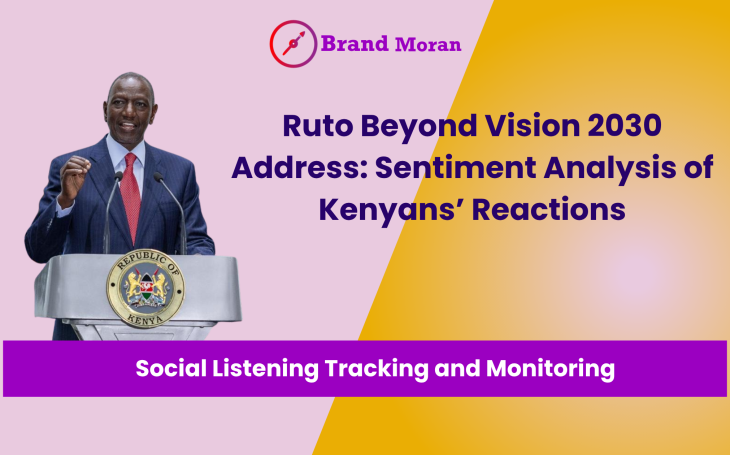
Ruto Beyond Vision 2030 sentiment analysis by Brand Moran shows that Kenyans’ reactions to President William Ruto’s Special National Address were more complex than the surface-level numbers suggested.
On July 30, 2026, President William Ruto delivered a Special National Address on the development of Kenya’s new national development vision: Beyond Vision 2030 from State House. The address invited Kenyans into what he described as one of the most consequential national conversations since the 2010 Constitution.
The speech framed Vision 2030 as approaching its horizon and proposed a new national development charter. According to the address, the charter would be shaped through public participation and formally launched on August 12, 2026.
The address leaned heavily on comparative economics. President Ruto referenced Kenya’s GDP per capita against countries such as South Korea, China, Vietnam, Ghana and Zimbabwe. He positioned the coming “National Conversation” as citizen-led rather than government-authored.
However, how the speech was delivered and how it was received are two different things. To understand the real public reaction, Brand Moran tracked online conversations around the address before and after it aired. The goal was to separate pre-speech promotional hype from genuine post-speech reaction.
What Brand Moran Monitored
Using Brand Moran’s social listening tools, we monitored mentions, hashtags and engagement tied to the address in two distinct windows: before the speech and after the speech.
This before-and-after approach was important because public sentiment can look very different depending on timing. Before a major national address, many posts are usually promotional. Supporters, pages and political allies may encourage people to tune in, share anticipation or frame the speech positively before the public hears the actual content.
After the speech, the conversation changes. People begin reacting to what was said, what was not said and how the message connects with their lived experiences.
For this analysis, Brand Moran tracked hashtags and keywords on the State of the Nation Address on X on 30th July 2026.
We also monitored related conversations mentioning the address, the President, the proposed national charter, Vision 2030 and political reactions linked to the speech.
What the Data Showed
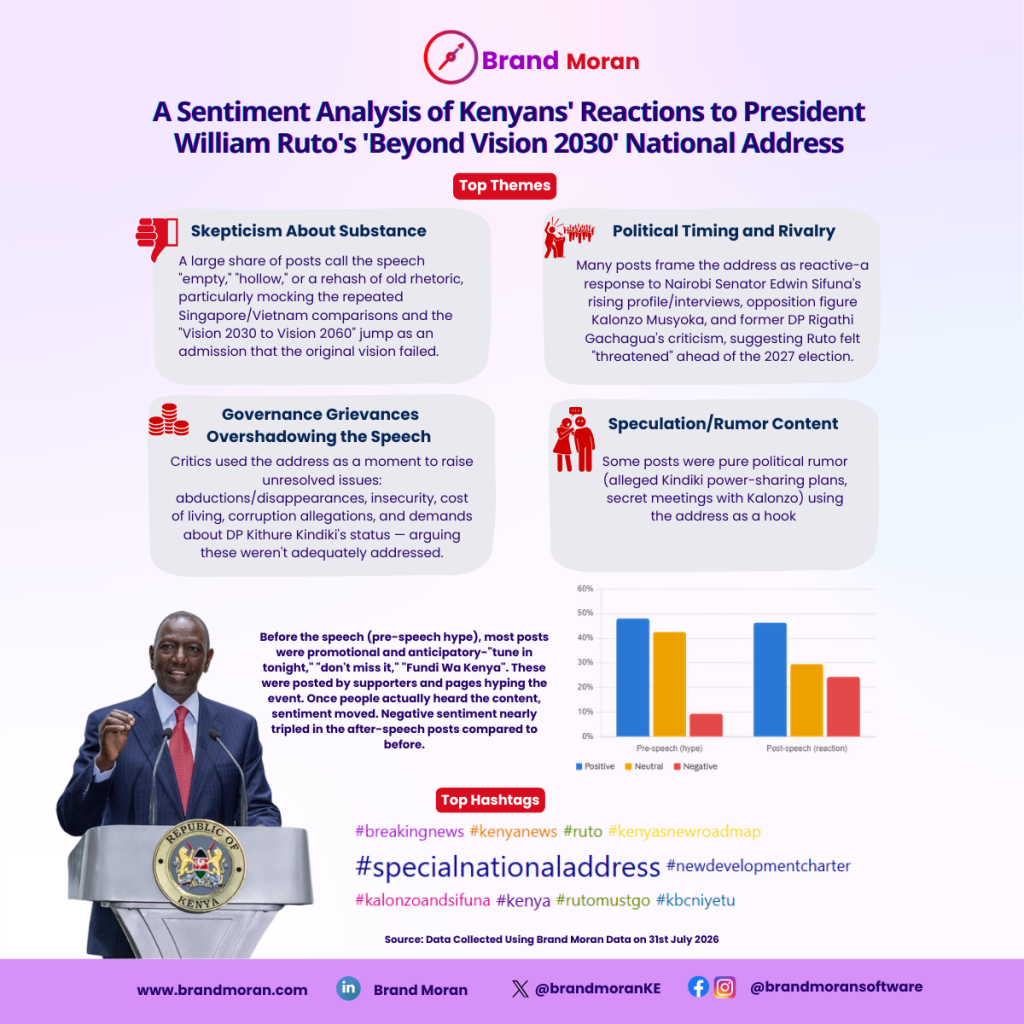
On the surface, the overall sentiment appeared largely positive. However, a closer look at the timeline showed a different story.
Before the speech, most posts were promotional. Common messages included phrases such as “tune in tonight,” “don’t miss it” and “Fundi Wa Kenya.” These posts created positive visibility and helped drive anticipation before the address.
At that stage, negative sentiment remained low because there was not yet much content for people to react to.
Once the address aired, sentiment shifted.
Negative sentiment nearly tripled in the post-speech period compared to the pre-speech window. Neutral posts also dropped sharply as more users moved from simply watching or waiting to expressing clearer opinions about the address.
This shows why timing matters in sentiment analysis.
A single aggregate sentiment score can hide the real story. If pre-speech hype and post-speech reaction are mixed together, the data may make public reception look more positive than it actually was after people heard the message.
Top Themes in the Conversation
Brand Moran identified four major themes in the post-speech conversation.
1. Scepticism About Substance of Address
A large share of posts questioned the substance of the address.
Some users described the speech as “empty,” “hollow” or a repeat of familiar rhetoric. Others focused on the comparison between Kenya and countries such as Singapore, Vietnam and South Korea, arguing that the examples did not fully connect with the immediate concerns many Kenyans face.
The shift from Vision 2030 to a possible Vision 2060-style roadmap also attracted criticism. Some users interpreted it as an admission that the original national vision had not delivered as expected.
2. Political Timing and Rivalry
Another major theme was political timing.
Many posts framed the address as reactive rather than purely developmental. Some users linked the speech to Nairobi Senator Edwin Sifuna’s rising political visibility, Kalonzo Musyoka’s opposition activity and criticism from former Deputy President Rigathi Gachagua.
In this theme, the speech was not discussed only as a development address. It was also interpreted through the lens of 2027 politics, opposition pressure and public confidence in the current administration.
3. Governance Grievances Overshadowing the Speech
A third group of users used the address as an opportunity to raise unresolved governance issues.
These included abductions and disappearances, insecurity, the cost of living, corruption allegations and questions around Deputy President Kithure Kindiki’s status.
For this group, the main concern was not the proposed national development charter. The concern was whether the government was addressing immediate issues affecting citizens.
This is an important communication insight. When public frustration is high, even a future-focused national address can be overshadowed by unresolved current grievances.
4. Speculation and Rumour Content
A smaller segment of the conversation focused on political rumours and speculation.
Some posts discussed alleged power-sharing arrangements, secret meetings and political realignments. In these cases, the national address became a hook for wider political speculation rather than a discussion of the speech itself.
This matters because public conversations around major political events are rarely limited to the official message. They often attract side narratives, rumours and unrelated political interpretations.
The Main Takeaway
The “largely positive” headline number was mostly driven by pre-speech hype volume, not clear post-speech approval. Before the address, supporters and pages helped create anticipation. After the address, genuine public reaction became more critical, more political and more focused on unresolved national concerns.
This is why sentiment analysis needs context.
A single number can mislead if it does not show when conversations happened, what triggered them and how sentiment changed over time. For communication teams, PR agencies, government institutions, NGOs and public-facing brands, this is a key lesson. Monitoring public reaction should not only show whether sentiment is positive, negative or neutral. It should also explain why people feel that way and when the shift happened.
Why This Matters for Communication Teams
The reaction to the Beyond Vision 2030 address shows the value of monitoring conversations in real time.
For public institutions, national campaigns and high-stakes announcements, communication teams need to know more than reach and engagement. They need to understand public mood, emerging criticism, stakeholder narratives, influential voices and the issues that may affect trust.
A strong monitoring setup can help teams answer important questions:
- What are people saying before and after an announcement?
- Which hashtags are shaping the conversation?
- What themes are gaining attention?
- Is sentiment improving or worsening?
- Are people reacting to the message or to wider political issues?
- Which concerns need clarification, response or further engagement?
Without this context, teams can mistake visibility for approval.
How Brand Moran Helps
Brand Moran helps brands, NGOs, government agencies, state corporations, regulators and PR teams monitor public conversations across social media, online platforms and media sources.
We track sentiment, hashtags, brand mentions, keywords, leadership mentions, share of voice and emerging issues. We also prepare daily and monthly monitoring reports that help teams understand what people are saying, where conversations are happening and what needs attention.
Need to know what your audience is really saying, and when it matters most?
Talk to Brand Moran for sentiment analysis, social listening, media monitoring and public reaction reports.
Contact: info@brandmoran.com