



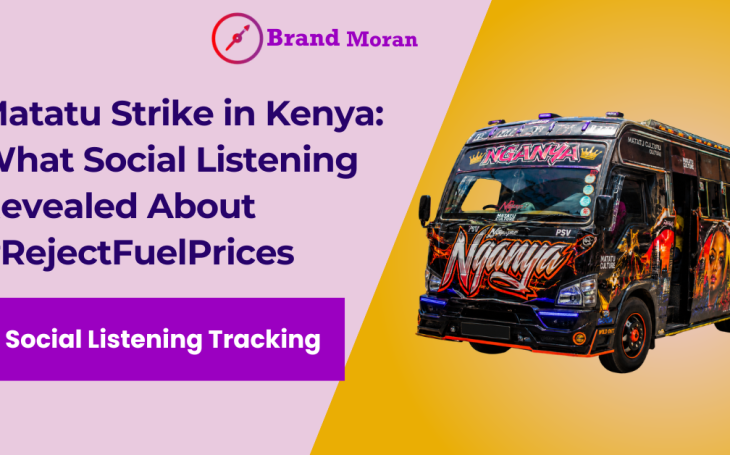
On Monday, May 18, 2026, Kenya woke up to a transport crisis that quickly became more than a matatu strike. What began as a protest against the latest fuel price increase turned into a national conversation about the cost of living, government accountability, public transport, urban planning, and the frustrations many Kenyans carry every day.
The strike followed EPRA’s May fuel review, which pushed Super Petrol in Nairobi to KSh 214.25 per litre and Diesel to KSh 242.92 per litre, with diesel recording one of the sharpest increases in the cycle. ublic transport operators responded with a shutdown, leaving commuters stranded across major towns and transport corridors. Media reports also indicated protests, road blockages, police confrontations, injuries, and deaths linked to the unrest.
At Brand Moran, we tracked conversations around the strike using our social listening and sentiment analysis tool. The conversation was driven largely by #RejectFuelPrices, with related mentions around matatus, fuel prices, police, Nairobi, paralysis, and commuters.
Our analysis captured over 2.9 million impressions and 1.6K+ mentions, with the overall sentiment score leaning clearly negative. The dominant emotion was anger, followed by frustration, while a smaller percentage of the conversation showed support or constructive discussion.
But beyond the numbers, the real story was in the themes.

1. Economic hardship was the strongest driver
The loudest theme in the conversation was economic pain. Kenyans were not only discussing fuel prices as a transport issue. They were connecting the hike to the larger cost of living crisis.
Many users framed the strike as a symptom of a population already under pressure from high food prices, expensive electricity, rising fares, and shrinking household budgets. In the conversation, fuel became the symbol of everything else that feels unaffordable.
This is why the anger was so intense. For many Kenyans, a rise in diesel prices does not remain at the pump. It moves into matatu fares, food transport costs, business operations, school runs, delivery charges, and daily survival.
The theme intensity around economic hardship and cost of living ranked highest in our analysis, scoring 95. This shows that the strike was not being interpreted as an isolated transport sector protest. It was being read as a national affordability crisis.
For brands and policymakers, this is important. When people talk about fuel prices online, they are often talking about much more than fuel. They are talking about pressure, fairness, survival, and trust.
2. Government accountability became a major anger point
The second strongest theme was government accountability and political blame.
Many conversations directly criticised the government’s handling of the fuel increase. Users questioned policy choices, leadership priorities, and the explanations given for the price hike. In particular, government explanations linking the increase to global pressures were met with resistance by many online users.
This theme scored 85 in our analysis and carried strong negative sentiment.
The pattern was clear: Kenyans were not only asking why fuel prices had gone up. They were asking who should be held responsible. That is where the conversation shifted from economics to politics.
In moments like this, public communication matters. When people are already angry, a technical explanation alone may not be enough. Citizens want empathy, clarity, accountability, and practical relief. Without that, every official statement risks being interpreted as dismissive.
For public institutions, this is one of the biggest lessons from the strike. In a digital environment, the public does not wait for formal press briefings to form an opinion. The narrative builds in real time, through posts, replies, quotes, memes, videos, and lived experiences.
3. Disruption turned the strike into a national moment
The third major theme was disruption.
The strike was described using words like “shutdown,” “paralysis,” “stranded,” and “blocked.” Conversations mentioned several affected areas, including Nairobi CBD, Githurai, Thika Road, Juja, Roysambu, Garissa, Mombasa, Nakuru, Kisumu, Meru, Bomet, Kapsabet, Naivasha, and other transport routes.
This theme scored 80, showing how strongly the public experienced the strike as a national disruption rather than a sector-specific labour action.
The online conversation was full of real-time updates: people asking whether routes were passable, warning others not to travel, sharing videos of blocked roads, reporting fare hikes, and describing confrontations between operators, riders, commuters, and police.
How is the situation on the roads in your area? Share here…
— Cyprian, Is Nyakundi (@C_NyaKundiH) May 18, 2026
This is where social listening becomes valuable. Traditional reporting may capture the main events, but social media shows how people experience disruption minute by minute. It reveals where anxiety is rising, which locations are becoming flashpoints, and what information people are urgently seeking.
For brands, especially those in transport, logistics, retail, delivery, banking, education, and public services, such disruptions are not just news. They affect operations, customer service, employee movement, supply chains, and public perception.
4. Many Kenyans saw the strike as organic, not politically manufactured
Another important theme was the framing of the strike as an organic grassroots movement.
A section of the conversation insisted that the anger was not manufactured by politicians but a section of government officials and politicians saw that it was politically manufactured. Users described the rejection of fuel prices as a genuine public reaction from people who feel pushed to the limit.
This matters because legitimacy shapes public response. When a protest is seen as politically organised, people may debate the motive. But when it is seen as organic, it can attract wider sympathy even from people affected by the disruption.
In our analysis, this theme scored 60 and carried a more neutral tone compared to the anger around the cost of living and government accountability. The conversation here was less about chaos and more about interpretation: who owns the protest, what it represents, and whether it reflects a deeper public mood.
For communicators, this is a key insight. Online conversations are not only about what happened. They are also about what people believe the event means.
5. The surprising positive signal: Nairobi without matatus
One of the most interesting themes was constructive.
Amid the frustration, some Kenyans observed that Nairobi CBD looked calmer, cleaner, and more walkable without matatus. This opened up a broader conversation about urban planning, CBD decongestion, public transport reform, and designated terminals outside the city centre.
Look at CBD without matatus.
They have shown us what beauty is like without them.
In future,the Gov’t will get rid of them.
Shauri yao. pic.twitter.com/ui1pNzNyKP— AntohKE (@therealantoh) May 18, 2026
This theme scored 45, making it less dominant than the anger-driven themes, but it stood out because it was the clearest positive signal in an otherwise negative conversation.
This is the kind of insight that can easily be missed when brands or institutions only track sentiment as positive, neutral, or negative. A crisis can carry frustration and still reveal constructive public ideas.
The matatu strike created an unexpected window into how Kenyans imagine a better city. Some were not celebrating the strike itself, but they were questioning whether Nairobi’s transport system should continue operating the way it does.
That is a powerful policy and planning insight.
Overall sentiment: negative, but layered
The overall sentiment around the matatu strike was negative.

In our sentiment breakdown, 74% of the conversation reflected anger, 18% reflected frustration, and only 8% showed support or constructive positivity.
But negative sentiment does not mean the conversation was one-dimensional.
The anger was rooted in economic pressure. The frustration was amplified by the disruption. The political blame reflected low trust. The grassroots framing showed public identification with the strike. And the CBD decongestion conversation showed that even in crisis, people can surface ideas for long-term change.
This is why social listening is important. It helps brands, media teams, policymakers, and institutions move beyond “people are angry” to understand why they are angry, where the anger is directed, what themes are growing, and what constructive signals are emerging.
What brands and institutions can learn from the strike
The matatu strike is a reminder that online conversations are now public intelligence.
When a national issue breaks, people not only consume the news. They document it, interpret it, challenge it, joke about it, organise around it, and attach it to bigger frustrations.
For brands, this means silence is not always neutrality. If your customers, employees, suppliers, or communities are affected, you need to understand the conversation before responding.
For public institutions, it means communication must be fast, human, and grounded in what people are actually saying. Technical explanations may be necessary, but they cannot replace empathy.
For media and researchers, it shows how social listening can reveal the emotional and thematic layers behind a breaking story.
The matatu strike was not just about fuel. It was about the cost of living, trust, public transport, and urban planning. It was about how quickly a policy issue can become a national digital conversation.
About Brand Moran
At Brand Moran, we believe every hashtag tells a story. The story behind #RejectFuelPrices was clear: Kenyans are not only reacting to price changes. They are speaking about pressure, accountability, and the kind of country and cities they want to live in.
Brand Moran is an AI-powered social listening and media monitoring platform built for African brands, organisations, agencies, and public institutions.
We help teams track what people are saying across social media and digital platforms, analyse public sentiment, identify emerging themes, monitor hashtags and campaigns, track brand reputation, and turn online conversations into actionable insights.
With Brand Moran, brands do not just see mentions. They understand the story behind the conversation, the emotions driving it, the key voices shaping it, and the opportunities or risks they need to respond to.
For businesses, government institutions, agencies, and communicators, Brand Moran provides the intelligence needed to make better decisions, manage reputation, improve campaigns, and stay ahead of public conversation.
Every hashtag tells a story. Are you listening?
Contact us: info@brandmoran.com