


Ruto vs Gachagua on X reveals an interesting contrast between audience size and actual content performance. Brand Moran analysed the accounts of President William Ruto and former Deputy President and DCP leader Rigathi Gachagua between 1 and 24 July 2026, comparing their followers, impressions, publishing activity and average engagement per post.
In political communication, follower count is often treated as the clearest indicator of influence. A political leader with millions of followers is expected to command greater reach, attract more engagement and dominate online conversations.
However, follower numbers do not always tell the complete story.
Brand Moran analysed the X accounts of President Dr William Ruto and former Deputy President and Democracy for Citizens Party (DCP) leader Hon. Rigathi Gachagua between 1 and 24 July 2026. The objective was to compare their audience sizes, publishing activity, impressions and average engagement per post.
The findings reveal two different forms of digital influence.
President Ruto has a substantially larger established audience and generates more discussion through replies and quoted posts. Gachagua, despite having a much smaller follower base, achieved almost the same number of impressions and recorded stronger performance across several engagement metrics.
The analysis demonstrates why political organizations, communication teams and public institutions must look beyond follower counts when measuring social media performance.
About the analysis of Ruto vs Gachagua on X
The Brand Moran analysis compared the two accounts across the following indicators:
- Total followers
- Total impressions
- Share of published posts
- Average likes per post
- Average reposts per post
- Average quoted posts
- Average replies per post
- Average bookmarks per post
These indicators help distinguish between potential audience size, content visibility, publishing activity and audience response.
It is important to note that engagement does not automatically represent political support. A reply, quoted post or repost may express agreement, criticism, curiosity or disagreement. The metrics show how audiences interacted with the content, but they do not independently establish sentiment or voting intention.
President Ruto maintains a substantial audience advantage
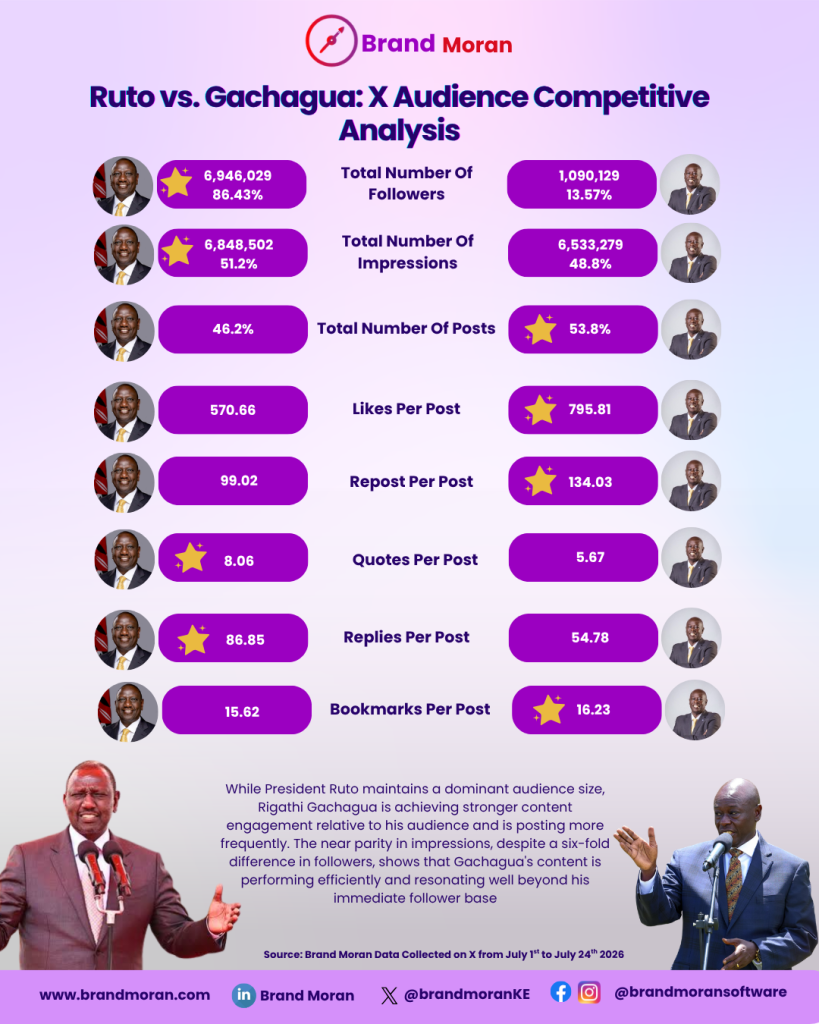
President William Ruto had 6,946,029 followers, representing 86.43% of the combined audience of the two leaders.
Rigathi Gachagua had 1,090,129 followers, accounting for the remaining 13.57%.
The difference gives President Ruto a considerable advantage in potential direct reach. His account can place content before a much larger established audience without relying entirely on reposts, recommendations or external amplification.
A large follower base also provides long-term communication value. It gives a political leader an existing distribution network that can be used for government announcements, policy communication, political messaging, event coverage and rapid responses to developing issues.
However, follower count represents potential exposure rather than guaranteed attention. Not every follower will see or interact with every post. Some followers may also be inactive, while a significant share of impressions may come from people who do not follow the account.
This is why follower numbers should be evaluated alongside impressions and engagement.
Near parity in impressions changes the picture
Despite the significant follower gap, the two accounts recorded almost equal impressions during the analysis period.
President Ruto generated 6,848,502 impressions, representing 51.2% of the combined impressions. Gachagua generated 6,533,279 impressions, accounting for 48.8%.
The difference in impressions was approximately 315,000, even though President Ruto had more than six times Gachagua’s follower count.
This is one of the most important findings from the analysis.
It suggests that Gachagua’s content travelled well beyond his immediate follower base. His posts may have benefited from frequent publishing, reposting, recommendations in users’ feeds, media attention and discussions involving supporters, critics and political commentators.
The figures should not be interpreted as unique reach because one person can generate several impressions. However, they still demonstrate that a smaller account can compete for visibility when its content is timely, relevant and actively distributed.
For communication teams, this is a reminder that audience size and content distribution are different measures. A large audience provides an advantage, but effective content can expand beyond the account’s existing community.
Gachagua followed a more active publishing strategy
Gachagua contributed 53.8% of all posts published by the two leaders during the analysis period. President Ruto accounted for 46.2%.
This means Gachagua was the more frequent publisher.
A higher posting frequency creates more opportunities for content to appear in feeds, attract reactions and enter ongoing conversations. It can also help a political account respond quickly to current events and maintain visibility across the day.
However, frequency alone does not guarantee performance. Posting more often can reduce average engagement when audiences become overwhelmed or when the additional posts provide limited value.
In this case, Gachagua combined higher publishing activity with stronger average performance across several engagement metrics. This indicates that his visibility was not driven by frequency alone. Individual posts were also attracting significant audience interaction.
Gachagua recorded stronger engagement per post
Gachagua outperformed President Ruto in average likes, reposts and bookmarks per post.
His posts generated an average of:
- 795.81 likes, compared with Ruto’s 570.66
- 134.03 reposts, compared with Ruto’s 99.02
- 16.23 bookmarks, compared with Ruto’s 15.62
Likes provide an indication of immediate audience reaction, although they do not fully explain why a user responded positively.
Reposts are particularly important because they increase the distribution of content. Every repost introduces the original message to another user’s network, allowing a political account to reach people who may not follow it directly.
Bookmarks can signal that users consider a post valuable, informative or worth revisiting. Although bookmarks were the closest-performing metric, Gachagua maintained a slight advantage.
Taken together, these findings suggest that Gachagua’s posts generated stronger engagement relative to the volume of content published. His audience may have been more responsive, or his messages may have been more closely connected to the political discussions taking place during the period.
President Ruto generated more conversation
President Ruto led in engagement indicators associated with public discussion.
His posts generated an average of:
- 8.06 quoted posts, compared with Gachagua’s 5.67
- 86.85 replies, compared with Gachagua’s 54.78
Replies and quoted posts require more effort than a like. They allow users to add opinions, ask questions, challenge a statement or introduce a post to a wider conversation.
President Ruto’s stronger performance in these areas indicates that his content attracted more direct commentary and public debate.
This may be partly connected to his position as President. Messages from the presidency are likely to receive responses from citizens, journalists, political opponents, civil society organizations, public institutions and other stakeholders.
However, higher reply and quote numbers should not automatically be interpreted as positive engagement. Political content can attract both support and criticism. Sentiment analysis would be required to determine whether the responses were favourable, neutral or negative.
The result nevertheless shows that President Ruto’s account remains a major centre of political conversation on X.
The two accounts demonstrate different forms of influence
The findings show that digital influence is multidimensional.
President Ruto’s account demonstrates audience scale and conversational influence. He has a dominant follower base and attracts more replies and quoted discussions per post.
Gachagua’s account demonstrates content efficiency and active audience mobilisation. His content generated impressions comparable to Ruto’s while achieving higher average likes and reposts from a much smaller follower base.
Neither form of influence should be assessed using one metric alone.
A political communication team focused only on followers might conclude that President Ruto completely dominates the comparison. A team focused only on likes and reposts might conclude that Gachagua has the stronger account.
A more accurate interpretation is that each account performed strongly in different areas.
What Political communication teams can learn from the analysis
The results have wider lessons for political parties, government institutions, brands and public figures.
First, follower count should not be used as the sole measure of influence. Teams should also examine impressions, engagement per post, posting frequency, sentiment, share of voice and the accounts amplifying the content.
Second, frequent publishing can support visibility when it is connected to relevant public conversations. More content is only effective when audiences continue to find it valuable or worth sharing.
Third, different engagement actions communicate different audience behaviours. Likes may show immediate reaction, reposts support distribution, replies encourage discussion, and quoted posts allow users to frame content through their own perspectives.
Finally, comparable impression figures do not necessarily mean the accounts have equal influence. Communication teams must consider the context, message themes, audience composition and sentiment behind the engagements.
Why does continuous monitoring matter?
A single analysis provides a useful snapshot, but political communication changes quickly.
Major announcements, political rallies, television interviews, public controversies and national events can significantly alter account performance. Monitoring these metrics over time can show whether an account is gaining momentum, losing audience responsiveness or becoming associated with particular topics.
Organizations should therefore monitor not only their own accounts but also:
- Mentions of leaders and spokespersons
- Campaign and policy keywords
- Public complaints and questions
- Hashtags connected to political discussions
- Sentiment around announcements
- Media and influencer amplification
- Competitor or opposing-party communication
This creates a more complete understanding of how messages move across the digital environment.
Conclusion
The Brand Moran analysis shows that President William Ruto maintains a clear advantage in follower size, while Rigathi Gachagua achieves stronger content engagement across likes, reposts and bookmarks.
More importantly, Gachagua generated almost as many impressions as President Ruto despite having a significantly smaller audience. President Ruto, meanwhile, continued to generate more replies and quoted posts, demonstrating his ability to attract wider public discussion.
The central lesson is clear: social media influence cannot be measured through follower count alone.
Organizations need to understand who is seeing their content, how people are responding, which messages are being amplified and whether the resulting conversations are positive, negative or neutral.
Brand Moran helps organizations monitor accounts, public figures, keywords, hashtags, media mentions and emerging conversations across digital platforms. Through daily monitoring, competitive analysis, sentiment tracking and automated reporting, communication teams can move beyond surface-level metrics and understand what their audiences are actually saying.
Book a Brand Moran demo to discover how your organization can measure digital conversations, compare account performance and make better communication decisions.
Source: Brand Moran analysis of data collected from X between 1 and 24 July 2026.